



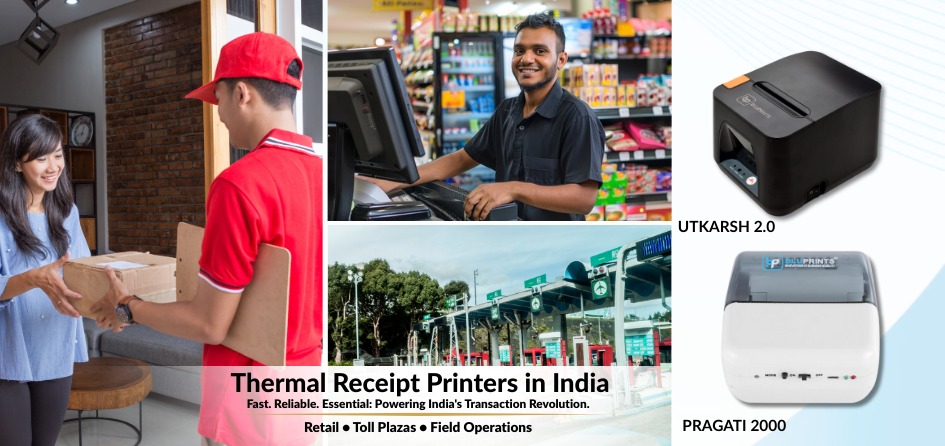
In India’s rapidly growing digital and transaction-driven economy, speed and accuracy are no longer optional—they are essential. Whether it is a busy retail store, a high-traffic toll plaza, or a field executive collecting payments on the move, reliable printing solutions play a critical role in daily operations. One such solution that has quietly transformed multiple industries is the thermal receipt printer.
Thermal receipt printers are widely used across India because they offer fast output, low maintenance, and dependable performance even in demanding environments. As transaction volumes increase across sectors, these printers have become a practical necessity rather than a luxury.
This blog explores the real-world use cases of thermal receipt printers in retail, toll plazas, and field operations in India, explaining why they are trusted across industries and how they improve efficiency at every level.
Understanding Thermal Receipt Printers
A thermal receipt printer uses heat to print text and images on special thermal paper. Unlike traditional printers, it does not require ink or toner. This simple technology results in fewer mechanical issues, lower operating costs, and faster print speeds.
In Indian conditions—where dust, heat, and continuous usage are common—thermal receipt printers are especially effective. Their compact size and durability make them suitable for both fixed counters and mobile operations.
Why Thermal Receipt Printers Are Essential in India
India’s operational environment presents unique challenges:
- High customer footfall
- Long working hours
- Limited counter space
- Cost-sensitive operations
Thermal receipt printers address these challenges by offering:
- Instant printing without delays
- Minimal maintenance requirements
- Clear and legible receipts
- Long operational life
This is why adoption of thermal receipt printers in India has grown steadily across public and private sectors.
Use Case 1: Retail Stores and Supermarkets
Fast and Efficient Billing
Retail is one of the largest users of thermal receipt printers. From local shops to large supermarkets, every transaction requires a receipt that is quick to print and easy to read.
Thermal receipt printers help retail businesses by:
- Reducing checkout time
- Handling high billing volumes
- Printing GST-compliant receipts
- Supporting barcode and QR code printing
In busy retail environments, even a few seconds saved per transaction can significantly reduce queues and improve customer satisfaction.
Inventory and POS Integration
Modern retail stores use POS systems to manage inventory, pricing, and sales reports. Thermal receipt printers integrate smoothly with these systems, ensuring seamless operation.
They are commonly used for:
- Sales receipts
- Return and exchange slips
- Discount and promotional coupons
- End-of-day reports
Their reliability ensures uninterrupted billing even during peak hours.
Use Case 2: Toll Plazas and Highway Infrastructure
High-Speed Transaction Handling
Toll plazas across India process thousands of vehicles every day. Any delay in receipt printing can cause traffic congestion and frustration for commuters.
Thermal receipt printers are ideal for toll operations because they:
- Print receipts instantly
- Work efficiently in outdoor conditions
- Require minimal maintenance
- Operate continuously without overheating
This makes them suitable for round-the-clock toll collection.
Support for Digital and Manual Payments
While digital toll systems are growing, printed receipts are still essential for record-keeping, audits, and customer reference. Thermal printers provide consistent output regardless of payment mode.
They are used for:
- Toll payment receipts
- FASTag transaction backups
- Vehicle entry and exit slips
- Compliance documentation
Their speed ensures smooth traffic movement and operational efficiency.
Use Case 3: Field Operations and Mobile Workforce
Printing on the Move
Field operations demand flexibility. Employees often work in remote locations with limited infrastructure. Portable thermal receipt printers solve this challenge by enabling on-site printing.
These printers are widely used in:
- Logistics and delivery services
- Utility bill collection
- Field inspections
- Government service delivery
With Bluetooth or wireless connectivity, they can be paired with mobile devices for instant printing.
Improving Accuracy and Trust
Providing a printed receipt at the point of service builds transparency and trust. It also reduces disputes and errors by offering immediate proof of transaction.
Thermal receipt printers help field teams by:
- Eliminating manual receipt writing
- Reducing human errors
- Ensuring accurate records
- Improving professionalism
Their lightweight design makes them easy to carry throughout the workday.
Industry-Wise Use Case Overview
| Sector | Application Area | Printer Type | Key Advantage |
| Retail Stores | Billing & invoices | Desktop thermal receipt printer | Faster checkout |
| Supermarkets | POS receipts & coupons | POS thermal printer | High volume handling |
| Toll Plazas | Toll & transaction receipts | High-speed thermal printer | Traffic efficiency |
| Logistics | Delivery confirmation | Portable thermal printer | Mobility |
| Field Services | On-site payment receipts | Bluetooth thermal printer | Instant proof |
| Public Services | Fee collection & service slips | Compact thermal printer | Accuracy |
Key Benefits Across All Use Cases
Low Operating Cost
Since thermal printers do not require ink or toner, long-term operational costs are significantly reduced.
Minimal Downtime
Fewer moving parts mean fewer breakdowns, which is crucial in high-traffic environments.
Compact and Space-Saving
Their small footprint makes them ideal for counters with limited space.
Consistent Print Quality
Receipts remain clear and readable, which is important for audits and customer reference.
Choosing the Right Thermal Receipt Printer
To get the best results, businesses should consider:
- Daily transaction volume
- Indoor or outdoor usage
- Connectivity needs
- Paper size compatibility
- Power source requirements
Selecting the right model ensures smooth operations and long-term reliability.
Future of Thermal Receipt Printers in India
As India continues its push toward digitization, the need for quick and reliable transaction records will only increase. Thermal receipt printer will remain a core component of:
- Retail modernization
- Infrastructure development
- Mobile workforce expansion
Their adaptability ensures they remain relevant across evolving use cases.
Frequently Asked Questions (FAQs)
1. Why are thermal receipt printers preferred over ink printers?
Thermal receipt printer do not use ink, which reduces maintenance, lowers cost, and increases reliability.
2. Are thermal receipts suitable for Indian weather conditions?
Yes, thermal printers are designed to perform well in heat, dust, and high-usage environments.
3. Can thermal receipt printers be used in mobile operations?
Yes, portable models are widely used in field operations due to their compact size and wireless connectivity.
4. Do thermal receipt printers support digital payment systems?
They integrate easily with POS systems and mobile devices used for digital transactions.
5. Are thermal receipts legally acceptable?
Thermal receipts are commonly used for compliance, record-keeping, and audits across industries.
Conclusion
From retail counters to toll plazas and on-ground field operations, thermal receipt printers have become an indispensable part of India’s transaction ecosystem. Their speed, reliability, and cost efficiency make them ideal for businesses and institutions handling high volumes of daily transactions.
As operational demands continue to grow, thermal receipt printers will remain a trusted solution—quietly supporting efficiency, accuracy, and transparency across India’s most critical industries.



Leave a comment